

Top Integrated Propulsion Technologies Powering Next-Gen Defense Platforms
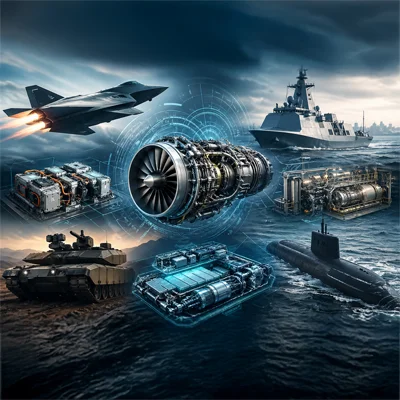
Propulsion is quietly becoming the deciding factor in modern defense capability.
It’s no longer just about how fast a platform can move or how far it can go. In today’s environment—where missions are multi-domain, contested, and data-driven—the propulsion system is essentially the energy backbone of the entire platform. Everything else depends on it: sensors, weapons, communications, endurance, and even stealth.
That’s why defense programs across air, land, and sea are shifting toward integrated propulsion systems for defense instead of treating engines as isolated components.
Why propulsion has moved to the center of defense design
For a long time, propulsion was treated as a “given” in platform development. Planes had engines, boats had turbines or diesel engines, and tanks had combustion engines. Each was optimized independently.
That approach is breaking down.
Recent defense needs are requiring engineers to consider propulsion as an enabler, not just an isolated component. Missions now demand:
- longer range with fewer refueling points
- lower detectability (heat and noise reduction)
- flexible power distribution across onboard systems
- faster response and acceleration in combat scenarios
This is where next-generation propulsion solutions for military platforms are fundamentally different—they are built around integration, not isolation.
Military engines are becoming intelligent systems
Military engines are no longer just high-performance combustion machines.
What’s changing is the amount of intelligence built into them. Modern systems continuously adjust performance based on altitude, load, temperature, and mission phase. In many cases, engines are now linked directly with onboard mission computers.
So instead of a pilot or operator manually “managing power,” the system does it dynamically.
This shift is central to advanced military propulsion technologies, where engines are expected to behave more like adaptive systems than fixed-output machines.
It also improves reliability. Condition-based maintenance - enabled by sensors - can identify failure patterns before they happen. In the case of defense fleets, it means better availability and reduced downtime.
Aerospace propulsion: where integration is most aggressive
Nowhere is propulsion innovation moving faster than in aerospace.
Aerospace propulsion systems are increasingly designed around variable operating modes. Aircraft are expected to perform multiple roles in a single mission—cruise efficiently, accelerate rapidly when needed, and remain thermally controlled to reduce detection risk.
This is driving development in:
- adaptive cycle engines
- advanced turbofan architectures
- improved thermal management systems
- tighter integration with flight control software
In practical terms, propulsion is no longer “set and forget.” It is continuously optimized in flight.
That is a defining feature of advanced propulsion systems for military aircraft and naval vessels—the system actively adapts instead of passively delivering thrust.
Integrated propulsion systems are changing architecture itself
The most important shift happening right now is architectural.
Integrated propulsion systems for defense combine propulsion, power generation, cooling, and energy storage into a single managed ecosystem.
Why does that matter?
Because modern platforms are no longer just “vehicles.” They are mobile power hubs. Radar systems, electronic warfare suites, communication nodes, and weapon systems all compete for energy.
Integration allows that energy to be distributed intelligently.
For example:
- excess engine energy can support onboard electronics
- electrical loads can be balanced with propulsion demand
- heat can be recycled or directed
This is particularly important for stealth operations, where thermal and acoustic emissions are key concerns - as is speed.
Hybrid and electric propulsion is no longer experimental
Hybrid and electric propulsion systems for defense are moving from concept to deployment.
We’re not talking about full electrification of heavy combat platforms yet—that’s still limited by energy density. But hybrid architectures are already making a difference.
In naval systems, hybrid setups allow vessels to switch to electric mode for quiet movement. That’s a major tactical advantage in surveillance or submarine-adjacent operations.
In ground systems, electric torque improves low-speed control and off-road mobility, while combustion engines provide sustained range.
Unmanned platforms benefit even more. Electric drives are quiet, efficient and easy to maintain, which is important for persistent surveillance operations.
Efficiency is now a battlefield requirement
High-efficiency propulsion solutions for modern defense applications are not just about fuel savings.
They directly influence mission planning.
More efficiency means:
- longer patrol windows
- fewer logistics dependencies
- reduced vulnerability during refueling
- better endurance in remote theaters
That's why propulsion systems consider doctrine as well as engineering.
Increased efficiency at even low levels can make a great difference when applied to the fleet.
Naval and ground propulsion are converging toward hybrid models
Naval propulsion has already moved significantly toward hybrid configurations.
Today, propulsion is increasingly based on a mix of gas turbines, diesel and electric drives as required. This optimises performance and survivability.
On land, armored platforms are following a similar direction.
Hybrid propulsion systems are improving:
- torque delivery in difficult terrain
- acceleration under load
- silent movement capabilities in tactical situations
What’s interesting is that both domains—naval and ground—are converging toward the same principle: propulsion systems must adapt in real time rather than operate at fixed efficiency points.
Where propulsion is heading next
The next phase of next-generation propulsion solutions for military platforms will likely be defined by three shifts:
1. Electrification where feasible
Not full replacement, but hybrid-first design thinking.
2. AI-driven energy management
Propulsion systems that continuously optimize output based on mission conditions.
3. Deeper system integration
Propulsion will not just support systems—it will actively coordinate with them.
Longer term, hypersonic platforms and alternative fuels like hydrogen will push propulsion into even more extreme engineering territory, especially around heat resistance and energy density.
Final thought
Propulsion is quietly becoming the “hidden layer” of modern defense capability.
Weapons may define strike power, sensors may define awareness, but propulsion defines how far, how fast, how silently, and how sustainably a platform can operate.
That’s why integrated propulsion technologies for next-gen defense platforms are now at the center of aerospace and defense innovation—not as an upgrade, but as a redesign of how platforms are fundamentally built.
 Our Services
 Media Pack Download
 Newsletters
 Industrial Events